Why Your AI Prompts Fail — And How to Fix Them
April 4, 2026 · AI
A short guide to prompt bliss
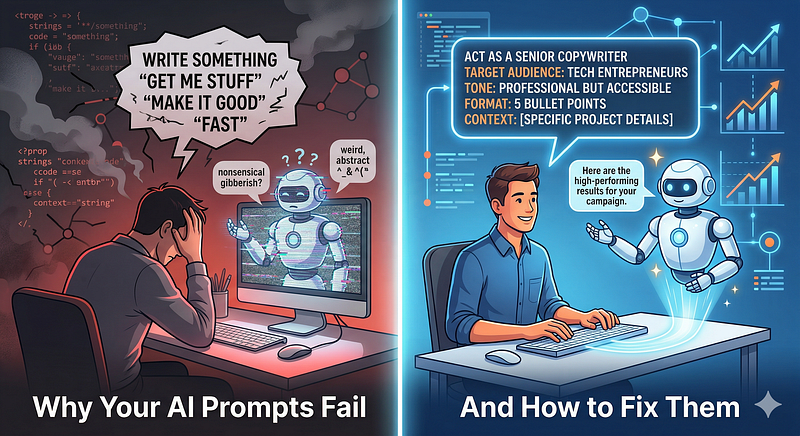
Most people who struggle with AI outputs assume the model is to blame. In reality, the problem is almost always the prompt. A language model is a precise instrument — give it a vague instruction and it will produce a vague result, reliably and without complaint. The good news is that prompt quality is not a matter of talent or intuition. It’s a set of measurable, learnable skills. In this post we will try to score prompts across seven distinct dimensions; clarity, precision, chain-of-thought, information completeness, constraint verifiability, structural compliance and informational integrity.
These dimensions are based on state-of-the-art research papers and the goal is to provide a fast and non-probabilistic method to evaluate prompts. Each one addresses a different failure mode. Understanding them changed how I write prompts — and it will change how you write them too.
These seven dimensions are not a checklist to run through manually before every prompt. They’re a set of intuitions that, once internalized, change how you write. You dont have to score 5 to all dimensions at once to achieve what you want and extract the value you require from anLLM.
First, lets analyze the dimensions
We are going to provide a brief description and analysis of those dimensions. Each dimension can be typically scored from 1 to 5.
Clarity — say what you mean
The most fundamental failure in prompt writing is ambiguity. Not the dramatic kind, where you contradict yourself, but the quiet kind — a pronoun without a referent, a task that could be read two different ways, an implied subject that the model has to guess. The test for clarity is simple: could a stranger read your prompt and know immediately what output you expect? If there’s any room for interpretation, there’s room for a bad answer.
“Explain it to me” is the canonical example. It scores a 1. The model has no idea what “it” refers to. Compare that to: “Explain how HTTPS works to a junior developer. Cover the TLS handshake, certificates, and why it matters for security. Use simple analogies.” The topic, the audience, the sub-topics, and the style are all explicit. That’s a 5.
Precision — Replace Adjectives with Numbers
Even a clear prompt can be imprecise. “Write a short summary” is perfectly clear — you want a summary — but “short” is subjective. One writer’s short is another’s paragraph. The model will pick an interpretation and commit to it, and there’s a 50% chance it won’t match yours.
“Give me a good list of marketing ideas” scores a 1. “Give me 10 low-budget marketing ideas for a B2C SaaS product targeting freelancers. Each idea should be actionable in under a week” scores a 5.
Precision means replacing vague modifiers with concrete, measurable requirements. Not “short” but “100 words.” Not “a list” but “exactly 10 items.” Not “professional” but “formal register, second-person, no contractions.”
Chain-of-Thought — Guide the Reasoning
One of the most reliably effective prompt techniques is also one of the most underused: asking the model to reason step by step. When a model jumps straight to an answer — especially on complex reasoning or arithmetic tasks — it frequently makes errors that step-by-step reasoning would have caught.
The difference is not subtle. “What is 17% of 340?” often produces a wrong answer. “Calculate 17% of 340. Show each step: first convert the percentage to a decimal, then multiply. Verify by estimating the answer first” produces a correct one. The instructions didn’t change the model’s capabilities — they changed its process.
Information Completeness — Don’t Make the Model Invent
Every gap in your prompt is a decision the model makes on your behalf. Sometimes those decisions are fine. Often they aren’t — and you’ll never know they happened.
“Write me an email” forces the model to invent the sender, the recipient, the purpose, the tone, and the appropriate length. The result will be technically an email, but it won’t be your email. The improved version — specifying the role, the recipient’s situation, the word limit, the tone, and a clear call-to-action — leaves nothing to be assumed.
Constraint Verifiability — Write Rules, Not Adjectives
There is a category of prompt instruction that sounds specific but isn’t: “professional,” “engaging,” “concise,” “natural-sounding.” These adjectives feel like constraints, but they’re not — they’re preferences. A constraint is something you can verify mechanically, something that either passes or fails.
“Write a professional and engaging LinkedIn bio” gives the model enormous latitude. “Write a LinkedIn bio of exactly 3 sentences. Use first person. Avoid the words ‘passionate’, ‘driven’, and ‘results-oriented’. Include my job title, company, and one measurable achievement” gives it almost none. Every requirement can be checked by a script — or by you, in ten seconds.
Structural Compliance — Define the Output Format
Without explicit format instructions, a model defaults to free-form prose. That’s often fine for conversational exchanges, but it fails the moment you need structured output — for downstream processing, for consistency across runs, or simply because your use case demands a specific shape.
The fix is to describe the format as explicitly as you describe the content. “Summarise the meeting notes below” leaves format entirely to the model. “Summarise the meeting notes using this structure: Decisions Made as a bullet list, Action Items as a table with Owner, Task, and Deadline columns, Open Questions as a numbered list — total under 200 words” produces the same output every time, in a form you can actually use.
Informational Integrity — Don’t Contradict Yourself
The last dimension is the subtlest: internal consistency. It’s easy to write a prompt that contains mutually exclusive requirements. When that happens, the model has to pick one to satisfy and silently violate the other. The result often looks like the model “got it wrong” — but the model was actually responding correctly to an impossible instruction. Read your prompt and ask: can all of these requirements be true at the same time? If the answer is no, you need a priority rule, not a better model.
The Evaluation
Bold claims without tangible evidence usually does not have real value. So, how do we know that this dimensions have meaning, or even work in real-life situations?
We designed an evaluation that compared the results for those evaluations of our tool Promptivo against an LLM-based evaluation. So we gave Gemini-2.5 flash those dimensions and asked it to evaluate prompts for us, a typical LLM-as-a-judge model.
The dataset was the IFEval dataset, which consists of 539 prompts. We did five (5) independent runs with the Gemini model. But it the LLM consistent? yes … and no.
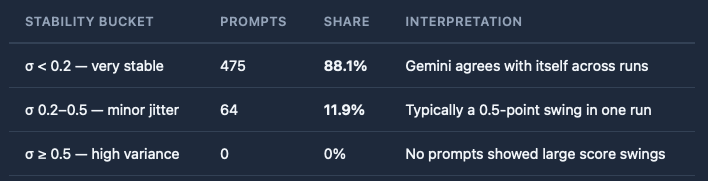
Ok that LLM does not always agree — completely — with itself. But overall is consistent.
Ok, now how it compares with our tool? The results were really surprising.
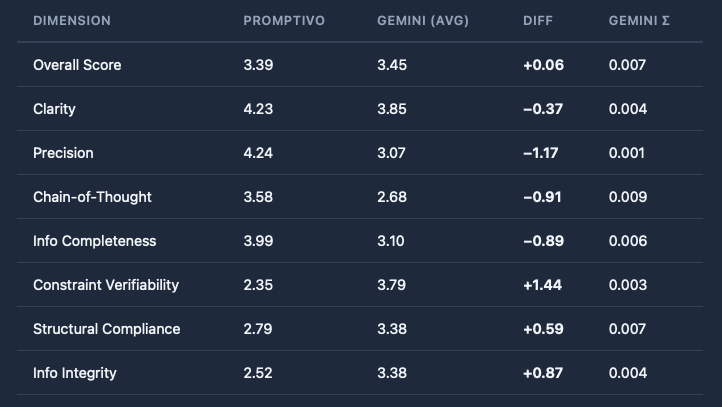
Constraint Verifiability shows the largest Promptivo–Gemini gap (+1.44), yet the lowest inter-run variance (σ = 0.003) — meaning Gemini is consistently more generous on this dimension, not just occasionally. Conversely, Precision shows the largest gap in the other direction (−1.17): Promptivo’s pattern engine reliably detects quantified language and specificity markers that Gemini’s holistic read may underweight. These are systematic, stable disagreements — not noise.
21 of 539 prompts (3.9%) had |avg Gemini − Promptivo| > 1.5 points. Inspection shows a clear pattern: prompts Gemini scores high but Promptivo scores lower tend to be short, semantically clear requests (e.g. “Answer in lowercase only”) where the constraint is obvious to a reader but lacks explicit structural markers that Promptivo’s pattern engine scores. The reverse — Promptivo higher — occurs on structurally rich prompts that include many formatting cues and verifiable requirements, which Gemini may deflate if the underlying request is vague.
Finally, Gemini and Promptivo reach near-identical overall averages (3.45 vs 3.39 across 539 prompts) but measure complementary signals. Gemini is remarkably self-consistent (88% of prompts stable across 5 runs, avg σ = 0.036), yet its dimensional profile diverges from Promptivo’s by up to 1.44 points. The near-zero Pearson correlation (r = 0.035) confirms these are independent perspectives — not redundant. Promptivo delivers deterministic, zero-cost results; Gemini applies semantic comprehension. Together they provide a richer picture than either approach alone.
Epilogue
It seems from the benchmark results that each tool is a part of an optimization pipeline, since they optimize and judge the prompts from a different angle.
If you like to read more about these methods, visit the following links:
Benchmarks (IFEval and MePO) — https://promptivo.wizhut.tech/benchmarks
A short guide with examples — https://promptivo.wizhut.tech/guide
or you can register and tryPromptivo for free.