Founders are not replaceable parts
November 14, 2026 · Engineering Management
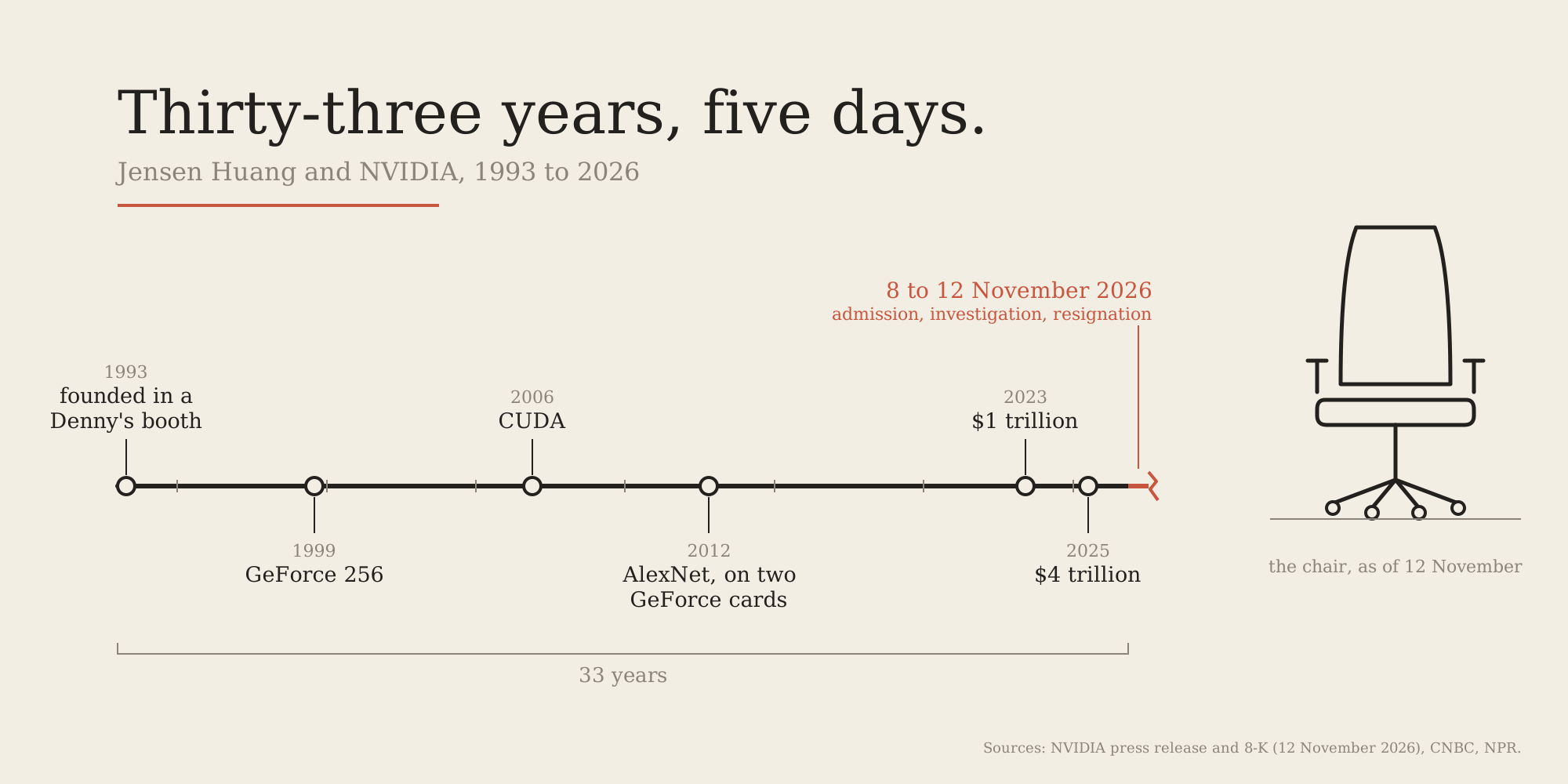
Last week was a bit crazy for NVIDIA.
On Sunday, 8 November, Jensen Huang sent an email to his staff and admitted that he had been unfaithful to his wife. The New York Times and the Financial Times had reported that the woman, an executive at Megaspeed (a Singapore customer of NVIDIA), is believed by US intelligence to have been recruited by China's Ministry of State Security. The board opened an independent investigation the same day.
On Wednesday the Times reported a second relationship, with a vice president who reported to him, and the Wall Street Journal reported that the board was preparing to remove him.
On Thursday NVIDIA announced that he had resigned as President, CEO and director, effective immediately. Colette Kress, the CFO (Chief Financial Officer), is interim CEO, and the search for a permanent one is open to outsiders.
Thirty-three years, from a booth in a Denny's in San Jose to one of the most valuable companies on the planet, closed in five days. And before the investigation had reported anything.
The last part is the one that bothers me.
What we know, and what we do not
Let's separate the facts first, because the internet has not. The affair is confirmed; he said it himself, in writing, and he wrote that there is no excuse for it. The espionage story rests on anonymous intelligence sources, China's foreign ministry calls it baseless, and the board said it had no reason to believe that national security or NVIDIA's secrets were compromised. The relationship with a subordinate is reported by the Times, citing current and former employees, and nobody involved has confirmed it.
Ok, if the last two are true, they are serious.
A relationship with someone in your reporting line is a governance problem in any company (Brian Krzanich left Intel in 2018 for exactly that, if I remember correctly, and his was in the past). The CEO of a company that sells chips under export controls being a target of a foreign intelligence service is a national-security problem. I am not arguing otherwise. But an independent investigation exists precisely to answer those two questions, with outside counsel and with time, and the man was gone four days after it started.
The first item is a different thing. A man who cheats on his wife has hurt his family, and it is ugly, and it is theirs. It is not a company matter until something else makes it one. And the same man, with that same wife, put a large part of his fortune into a foundation; the Jen-Hsun & Lori Huang Foundation, with Lori Huang as its president, reported about $9.2 billion in assets in its 2024 filing. The compassion is real and so are the flaws, and every one of us carries both. We do not ask the people who run our companies to be saints; we ask them to be accountable, which is a different thing, and accountability comes with a process.
Who is replaceable?
There is a belief, in boardrooms and in a certain kind of business school, that a CEO is a role and a founder is simply the first person who happened to fill it. Write the job description, hire from the market, and the company carries on.
I have spent more than twenty-five years in software, ten of them in a company still run by one of its founders, and I have never seen this work in practice as smoothly as it does on a slide. A founder carries the reasons behind decisions that nobody wrote down, and the authority to make a bet the spreadsheet does not like. NVIDIA is the textbook case. CUDA shipped in 2006, when GPUs were for games, and for years (as I remember it) the analysts asked why a graphics company was spending money on scientific computing. Then in 2012 AlexNet was trained on two GeForce cards, and the rest is the AI industry as we know it. That kind of bet is made by someone who owns the company in more than shares.
The data is not only anecdote. Rüdiger Fahlenbrach studied large US firms from 1993 to 2002 and found that those led by their founder beat the benchmark by 8.3% a year, and by 4.4% after controlling for the firm, the CEO and the industry. It is one study, it covers the dot-com years, and it shows an association rather than a cause. But it is not nothing.
And we have run this experiment before. Apple pushed out Steve Jobs in 1985, and twelve years later, close to bankruptcy, bought NeXT and took him back. OpenAI's board fired Sam Altman on a Friday in November 2023; within days most of the company had signed a letter threatening to leave, and he was back the following week. Boards are very good at removing founders, and much worse at running what is left.
Whose fight is this?
NVIDIA is not an ordinary company any more. Rebecca Patterson at the Council on Foreign Relations called it "the so-called central bank for the AI ecosystem", and its chips are at the centre of the fight over what China may buy. Jensen Huang was the most effective voice on one side of that fight; in December 2025 the White House let NVIDIA sell H200s to Chinese buyers. On the other side, senators from both parties are pushing new bills to tighten the controls, and they wasted no time using the scandal to make their case.
So we have a story that senior officials reportedly knew about for months, reaching the papers when it did, removing that particular voice days before Trump meets Xi in Shenzhen, and days before Huang was due to brief a House committee. I do not know who decided when this story would break, and I am not claiming that any of it was invented. That is my personal reading and nothing more; no reporting has shown it. But when the timing of a scandal fits a policy fight this neatly, I start asking who benefits. And the answer is not NVIDIA's engineers, nor its shareholders.
Epilogue
Who pays the bill? The shareholders first; NVIDIA closed under four trillion dollars on Friday for the first time since July 2025. Then the people who build the roadmap, without the person who held it in his head. Then, if CJ Muse at Cantor Fitzgerald is right, the country that is supposed to be winning the AI race, because the US is now "giving up the lead in AI" (his words, not mine, and I hope he is wrong).
Jeffrey Sonnenfeld at Yale said of the board that "no one was equipped to step in", and he meant it as a criticism; a board that idolised its CEO and never planned his succession (Huang reportedly does not believe in succession planning). Ok, a board should prepare better than that.
In a way, Sonnenfeld was right. No one was equipped to step in. Some people you do not replace; you lose them.