The Hype vs. Reality of AI Agents: Lessons from Four Landmark Studies
April 19, 2026 · AI
It seems that coding is resolved at the interview level … :)
The promise of AI agents transforming software development and remote work has dominated news from 2023. Tools like Claude, Grok, and GPT models are marketed as autonomous workers that can handle everything from coding full apps to completing freelance projects. Yet a wave of 2025 research from Scale AI, Upwork, Stanford, and MIT paints a far more sobering picture. In reality, they confirmed one of my worse fears; we are far-far away from intelligence and full autonomy. Do not think I dont love the progress. I am one of the biggest fans, but in order to properly productize with real benefits, you have to understand the limitations. Things will improve of course, lets see.
Please note that this is a 2025 series of papers and the area is progressing with a rapid rate, but again I have not seen so much progress from late 2025 until now. More marketing than progress.
Why AI Agents Are Struggling
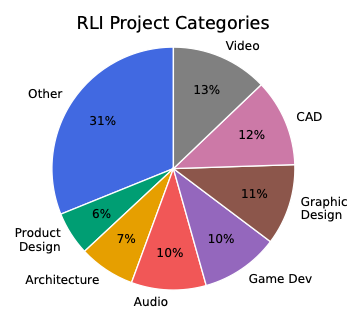
The most direct evidence comes from the Remote Labor Index (RLI) by Scale AI and the Center for AI Safety. Researchers assembled 240 real freelance projects worth over $140,000, sourced primarily from Upwork across 23 professional categories.
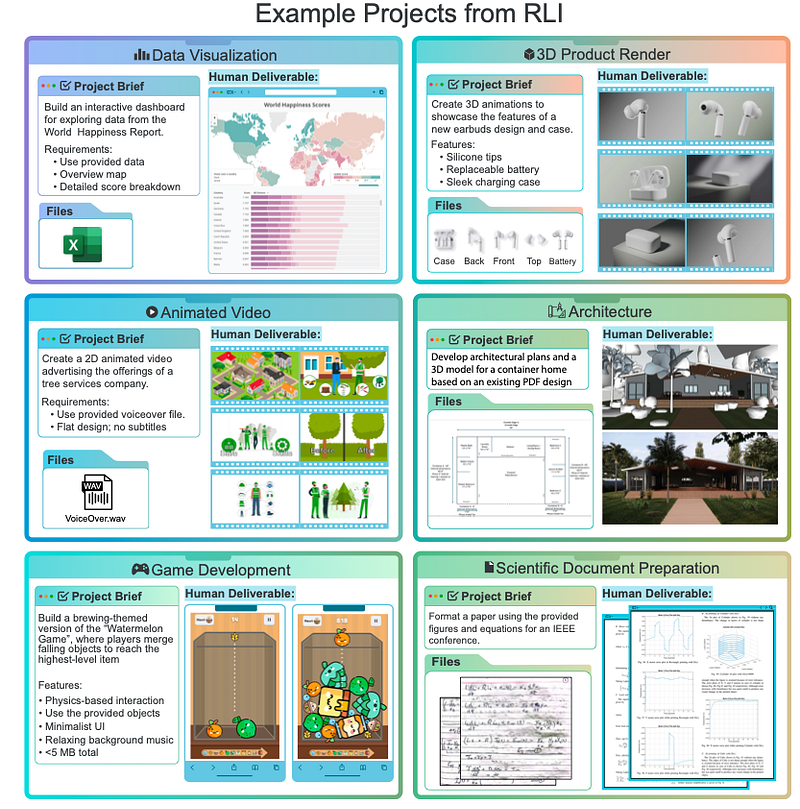
Professional freelancers had already delivered high-quality work for these jobs.
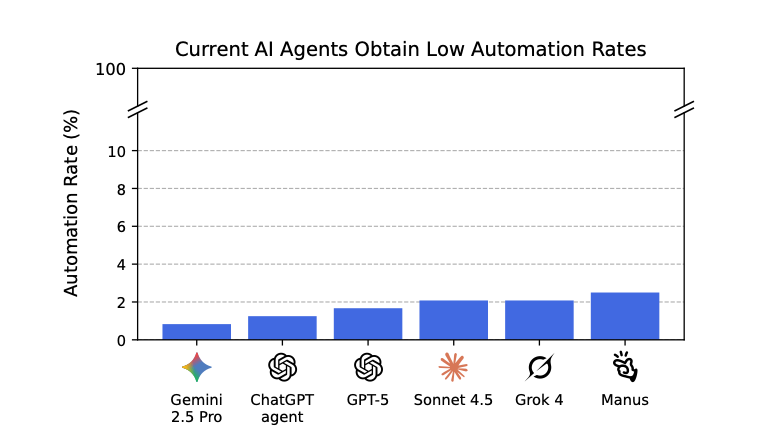
When state-of-the-art AI agents were tasked with the same projects, the best performer succeeded on just 2.5% of them. That means a 97.5% failure rate. Even top models like Grok 4 and Claude Sonnet 4.5 managed only 2.1%.
Failures were not subtle. A detailed breakdown of hundreds of evaluations showed:
- Poor quality: 45.6%
- Incomplete deliverables: 35.7%
- Corrupted or broken files: 17.6%
- Inconsistencies: 14.8%
These issues arose because real remote work demands end-to-end execution across diverse file types, verification of functional outputs, and professional standards that current agents simply cannot maintain consistently. Simple visualizations sometimes worked, but most software-related tasks involved integration, edge cases, or creative judgment that exposed the agents’ limitations. The RLI team concluded that today’s AI agents are “far from capable of autonomously performing diverse, economically valuable remote work.”
Complementary data from Upwork’s Human+Agent Productivity Index (UpBench), which analyzed 322 real fixed-price Upwork jobs, shows why pure automation fails. When agents worked alone, completion rates ranged from 19.6% (GPT-5) to 39.8% (Claude Sonnet 4). But when humans provided a single round of targeted feedback (a “human-in-the-loop” or HITL approach), performance jumped dramatically: absolute gains of 11–14 percentage points and relative improvements as high as 71%. Human oversight rescued 18–23% of otherwise failed tasks and improved overall quality scores by 40–70% on the jobs that initially failed.
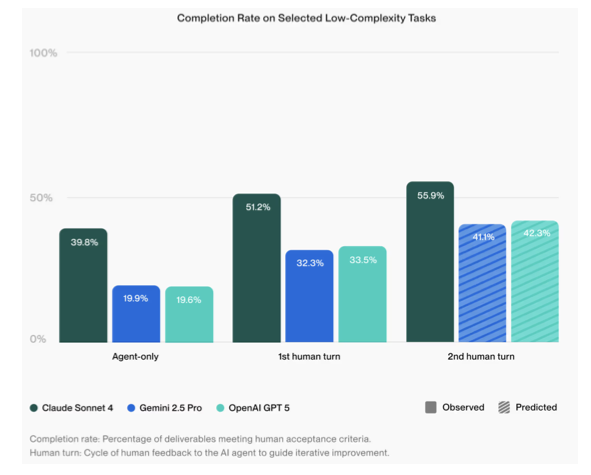
The lesson is clear: AI agents excel as powerful assistants but collapse without human judgment to catch errors, refine outputs, and steer direction.
This dynamic creates a new hidden cost: “workslop.” But what is this workslop? According to the website:
Workslop is AI-generated content that looks good, but lacks substance. It creates the illusion of progress — slick slides, lengthy reports, overly tightened summaries, or code without context.
A Stanford Social Media Lab and BetterUp Labs survey of 1,150 U.S. desk workers (September 2025) found that 40% had received AI-generated content in the past month that looked polished but lacked substance. Workers reported spending an average of 2 hours fixing each instance, with workslop making up roughly 15.4% of the material they receive. The economic toll is significant — an estimated $186 per employee per month, or $9 million annually for a 10,000-person company. Workslop doesn’t just waste time; it erodes trust, forces rework, and turns supposed productivity gains into net losses.
More specifically,

Finally, the MIT NAND A “State of AI in Business 2025” report explains why massive corporate investment hasn’t translated into results. Despite $30–40 billion spent on generative AI pilots, 95% of initiatives delivered no measurable revenue growth or P&L impact. Only 5% achieved rapid acceleration. The primary reasons? Companies avoided the necessary organizational friction — retraining teams, redesigning workflows, and maintaining human oversight — while over-relying on raw model capability. Without addressing the human-AI collaboration gap highlighted in the other studies, the technology remains stuck in pilot purgatory.
- Benchmark-reality mismatch: Agents shine on abstract tests but fail on the messy, multi-step, verifiable nature of paid professional work.
- Over-automation without guardrails: Removing humans entirely amplifies hallucinations, incompleteness, and low-quality output.
- Organizational inertia: Enterprises treat AI as a plug-and-play replacement rather than a collaborative tool, leading to wasted spend and workslop proliferation.
Epilogue
These findings are a reality check. The data consistently shows that the highest-leverage path forward is thoughtful human-AI partnership, not full replacement. When humans stay in the loop for guidance and quality control, agents become genuine multipliers. The studies also signal that future progress will depend less on raw model size and more on better benchmarks (like RLI), robust evaluation frameworks (like UpBench), and cultural shifts that treat AI as a skilled junior colleague.
For developers, freelancers, and companies, the message is pragmatic: use AI agents aggressively for ideation, boilerplate, and rapid prototyping — but keep human judgment as the final gatekeeper. The next chapter of AI in the workplace won’t be defined by how autonomous the agents become, but by how intelligently we integrate them with human expertise.
Bibliography
- Remote Labor Index (RLI): Mantas Mazeika et al., “Remote Labor Index: Measuring AI Automation of Remote Work,” arXiv:2510.26787 (October 2025). PDF: https://arxiv.org/pdf/2510.26787.pdf
- Upwork Human+Agent Productivity Index (UpBench): https://arxiv.org/pdf/2511.12306 (November 2025).
- Stanford Social Media Lab + BetterUp Labs: “Workslop: The Hidden Cost of AI-Generated Busywork” survey of 1,150 U.S. desk workers (September 2025). https://betterup.com/workslop
- MIT NAND A Initiative: “The GenAI Divide: State of AI in Business 2025” report (August 2025). https://mlq.ai/media/quarterly_decks/v0.1_State_of_AI_in_Business_2025_Report.pdf