Math, agents, and the call to slow down
September 20, 2026 · AI
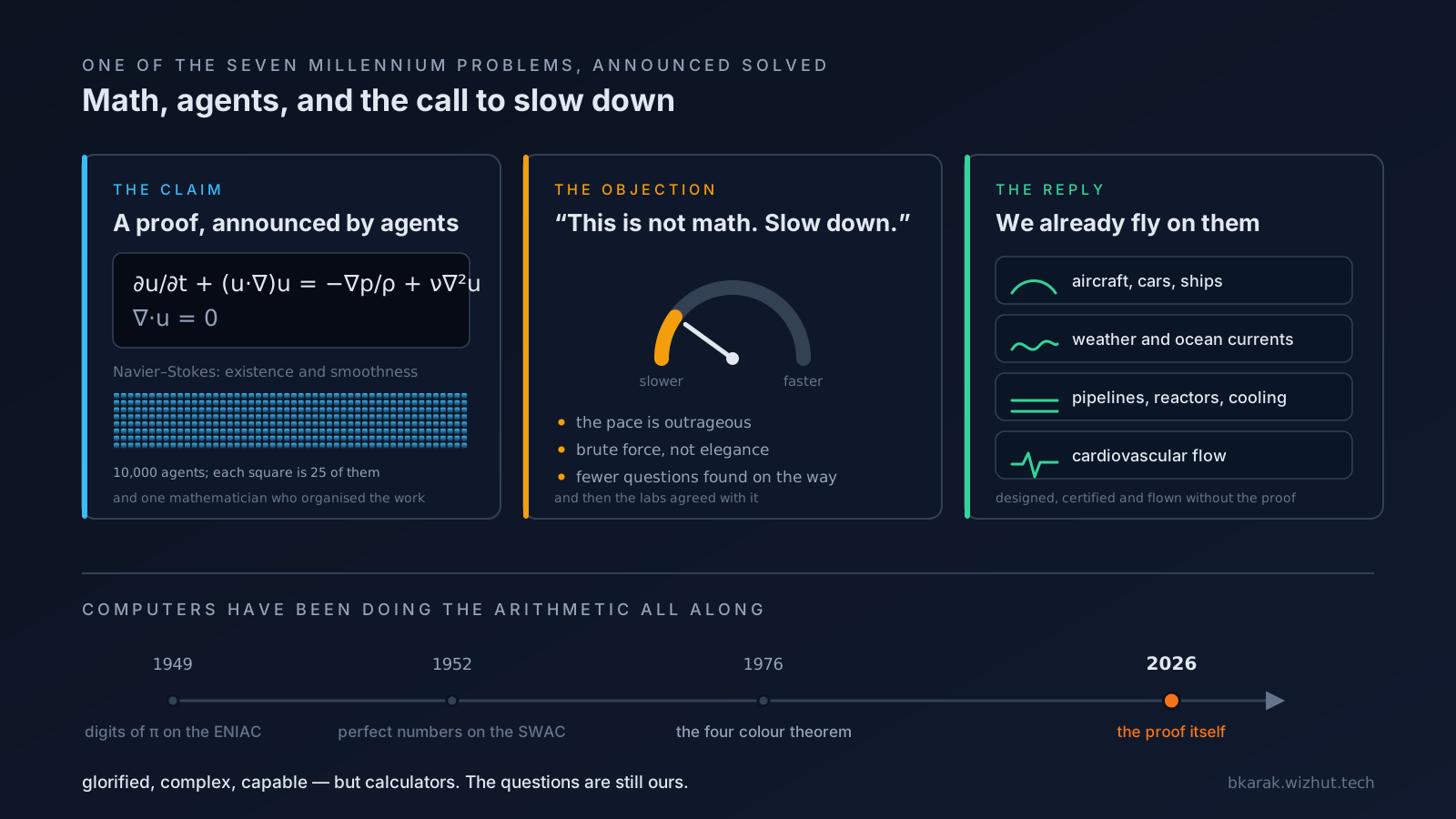
Last month it was a bit crazy for the mathematical world. Suddenly, OpenAI claimed that it had solved one of the Millennium Problems, the Navier-Stokes equation. Everyone was shocked.
After a few days Tristan Buckmaster went out to the public and in simple words, he said that he was working on the solution on ChatGPT, organized his work inside this system and his work was used by the 10k agents that solved the problem and claimed part (if not all) the solution to be attributed to him. Also he tried to prove that without his thinking, the OpenAI model would never be able to solve it.
After that a group of mathematicians, led by Terence Tao, said that "this is not math", "the pace is outrageous" and we should "slow down".
Then Anthropic's CEO, Dario Amodei, said that we should regulate AI evolution and then Elon Musk and Sam Altman agreed with that notion.
The last part was the one that panicked me a bit.
Spoiler: sanity prevailed in the end.
Math world under attack
So, it seems that Math is one of the last Bastion of human-kind, at least for AI frontier labs (I think making a robot do the dishes without breaking half of them is more difficult problem 😀), but here we are and all the most difficult problems seem to be under attack by AI agents. But is it really agents, or scientists with agents?
It seems the latter, but still the Math world published this on 2026-09-11 (endorsed fully by Fields medalists 😮), saying that the math world needs more time to understand the use and the role of AI in modern math research. The argument is that in a simplistic way, the process of proving something with AI tools, typically is more brute force and not elegant.
Also, that by destroying the process of proving a problem the traditional way, you are missing several opportunities of identifying interesting and challenging problems that will eventually create an ecosystem of ideas, essential to move forward the mathematical research.
Ok, to a certain point I found this logical as an argument.
Lets slow down then ...
So, we are discussing the following possibility right now. Instead of proving that those equations work, the world would be better, if we waited for a few years, to find a elegant way to do it, or found a way that it would not feel sudden.
I think we are having two conversations here; the first is around how AI will shape mathematics, and how to still prove problems in a way the progresses the field and second, how we can exploit this technology to prove, in a crude way that something is true or not and reap the benefits of that knowledge.
So, regarding those equations, they are used (according to Grok):
The Navier–Stokes equations are used in practice to model viscous flow of air, water, blood, and other fluids so engineers and scientists can design aircraft, cars, ships, pumps, and turbines; forecast weather and ocean currents; analyze cardiovascular flow and medical devices; optimize pipelines, chemical reactors, and cooling systems; and predict flooding, pollution, and other environmental transport.
Ok, so we all are discussing here that we were ok, than using them, without knowing that they worked or not and it would be cool to wait for 2-3 years to know that for certain, while we design aircraft, cars, ships and medical devices based on them.
Computation-at-large
From the dawn of the computers as we know them, they were used that way to prove or disprove certain theorems in Math. They were used to calculate primes by finding patterns on them, calculate perfect numbers, digits of Pi etc. That was not a problem in the past, because they were used as tools, as simple calculators.
That part remains the same though. The hyperscalers democratize the computation, in terms of compute and now on reasoning. Everyone can now do things that in the past seemed very difficult or undoable. They are simple calculators, glorified, complex, capable, but calculators.
I can assure you that no agent will go and solve any math problem, if a human do not instruct it to do it, and I am also sure that the agents was monitored all the time, stuck, crashed and fine tuned by humans during this process.
This rate of progress is a gift. Like the Golden Age of Athens. We should not deny it, because it is inconvenient for some people, we should all work to embrace it. To slow down AI development is like saying not using spreadsheets in Wall Street and going back to pen and paper, because when you do calculations by hand, they are better.
Epilogue
So, two separate things, the mathematicians can continue working on the problems they want, finding better solutions and generalizations, advancing and teaching the rest of us and the AI systems of human intellect, and leave also computers and GPUs to do their computations and be as brute force as they can be, answering problems.
In a way, Terence Tao was right, we should be the ones finding and posing the most interesting questions after all.