AI reverse engineering and the end of software (as we know it)
October 17, 2026 · AI
On September 30, someone pushed the first commit of PhotoCraft to GitHub. It is a photo editor written from scratch in Rust, it opens and saves PSD (Photoshop Document) files, and it looks very much like Photoshop. Brandon Thomas, who used to run storyteller.ai, built it with Claude Opus 5.5, as part of a project called ArtCraft.
Three days later, ArtCraft announced the rest of the Adobe suite. Illustrator, Premiere, Lightroom, After Effects, InDesign and Acrobat, all of them cloned. On October 7 it was Microsoft Office's turn, with WordCraft leading the pack.
The same week, REA (Reverse Engineer Anything), a tool that connects Claude Code and similar agents to Ghidra and IDA (the two classic disassemblers), went from fewer than 10,000 stars to more than 100,000 in six days. Then Super Mario Bros. Wonder appeared running natively on a PC, at 60 frames per second on a laptop with an RTX 3050, no emulator involved. Then Link's Awakening, the Switch remake, got a native port for Windows, macOS and Linux, built almost entirely with AI.
Then the PlayStation 5 fell. A public jailbreak called Relapse arrived on September 29, and in less than a week people were playing real PlayStation 2 discs at six times their native resolution, next to Switch and original Xbox emulators (on a PlayStation, I still cannot get used to this). On October 12, a store for jailbroken consoles called Overdrive offered more than 1,600 PS4 and PS5 games for free. Sony's lawyers had it closed in two days.
And then everyone declared the end of software.
That last part is the one I do not buy.
Robin Hood: Prince of Thieves
Before the technical part, let me deal with the comments, because a large part of the cheering around the PS5 had nothing to do with engineering.
In July, Sony announced that it will stop producing physical discs for new PlayStation games in January 2028. People were angry, publishers too, and Sony did not move (its Chief Financial Officer said they will "cautiously move this forward"). So when the jailbreak and the free store arrived, a lot of people felt they had the moral high ground. Evil Sony had it coming.
Ok, I also think that ending physical discs is a bad decision.
But one bad decision does not give anybody the right to steal. So, what we are saying is that because a company decided to stop pressing discs fifteen months from now, it is fine to download 1,600 games that thousands of developers, artists and testers spent years building, most of whom had no say in that decision and some of whom will lose their jobs when the next game does not sell. The people who made those games did not end the discs.
Back to the Future
Now, let us open the box, because what is inside is not what the headlines say.
PhotoCraft is not reverse engineered in the strict sense. Its authors call it a clean-room reimplementation; the model studied the behaviour, the menus, the screenshots and the public specifications, and never looked at Photoshop's binary. Mario and Zelda are static recompilations. The Switch game code is translated from ARM to x86 instructions at build time, and the graphics calls are mapped to Vulkan. The PS5 is a jailbreak, an exploit chain like every other exploit chain.
We have seen every one of these before (as we say in Greek, nothing new under the sun). DEC (Digital Equipment Corporation) shipped FX!32 in 1996, and it translated x86 Windows programs to run on Alpha machines. Rosetta 2 does the same trick on my M2 every day. Super Mario 64 was decompiled by hand in 2019, and Majora's Mask was statically recompiled for the PC in 2024, by people, the slow way. Every PlayStation since the first one has been opened, the first one with a mod chip and the PlayStation 3 with a USB stick and a signing key that Sony got wrong. And clean-room clones? Compaq cloned the IBM PC BIOS (Basic Input/Output System) that way in the early 80s, and Phoenix sold the result to everybody else.
What AI changed is the speed. And I can confirm this part personally; last month I handed a 74 KB DOS executable from 1997 (a text adventure I wrote with a friend as a student, source long gone) to Claude Code, and it was running in a browser the same afternoon. It is easy, uncomfortably easy. And it is fun.
But copying software was always easy. I have been around computers since 1983 or 1984 (do the math on my age, I will not help you :) ), and back then there was practically no legislation about software in Greece. If I remember correctly, software got proper legal protection only in 1993. So small shops all over the country sold copied games and programs over the counter, openly, as a normal business. You could have everything.
And today? You pay a small fee (or nothing at all) and the warez scene gives you every version of every program, cracked, for every platform, together with every film and every album. This has been true for thirty years.
So, if copying could kill software, software would have been dead since 1985.
Show me the money
So why is Adobe still in business? Because the people who use Photoshop for real are professionals. They get paid thousands of euros per project, and the tool is a small part of their cost. They pay for the support, the bug fixes, the new features, the plugins they collected over the years, and mostly for the guarantee that the file will open at the client (and at the printer) exactly as they saved it.
Of course, PhotoCraft is impressive, and I mean it. Two weeks from the first commit to tens of thousands of stars is not a small thing. But it is an alpha, and its blend modes and filters do not produce the same pixels as Photoshop, because Adobe tuned those algorithms for decades and you cannot copy what you cannot observe. Would you risk a project worth 5,000 euros on it, to save a subscription?
The same goes for Word. Microsoft 365 costs €99 per year, roughly €8 per month, and one estimate I read puts WordCraft at around 60% of what a professional needs. What exactly are we talking about here? Nobody is going to run a law firm on 60% of Word to save 8 euros.
And there is the question that nobody asked; who maintains PhotoCraft in 2029? Who fixes the bug that corrupts a file the night before a deadline? With Adobe there is a company on the other end, with a contract and a support line. With a clone generated in two weeks, there is an issues page on GitHub.
Epilogue
A few weeks ago it was the end of mathematics, now it is the end of software, and I am sure the end of physics is somewhere in the pipeline. We found a tool that gives us capabilities we could not imagine a few years ago, and every time it does something new, we declare the end of something old. Call it AI psychosis.
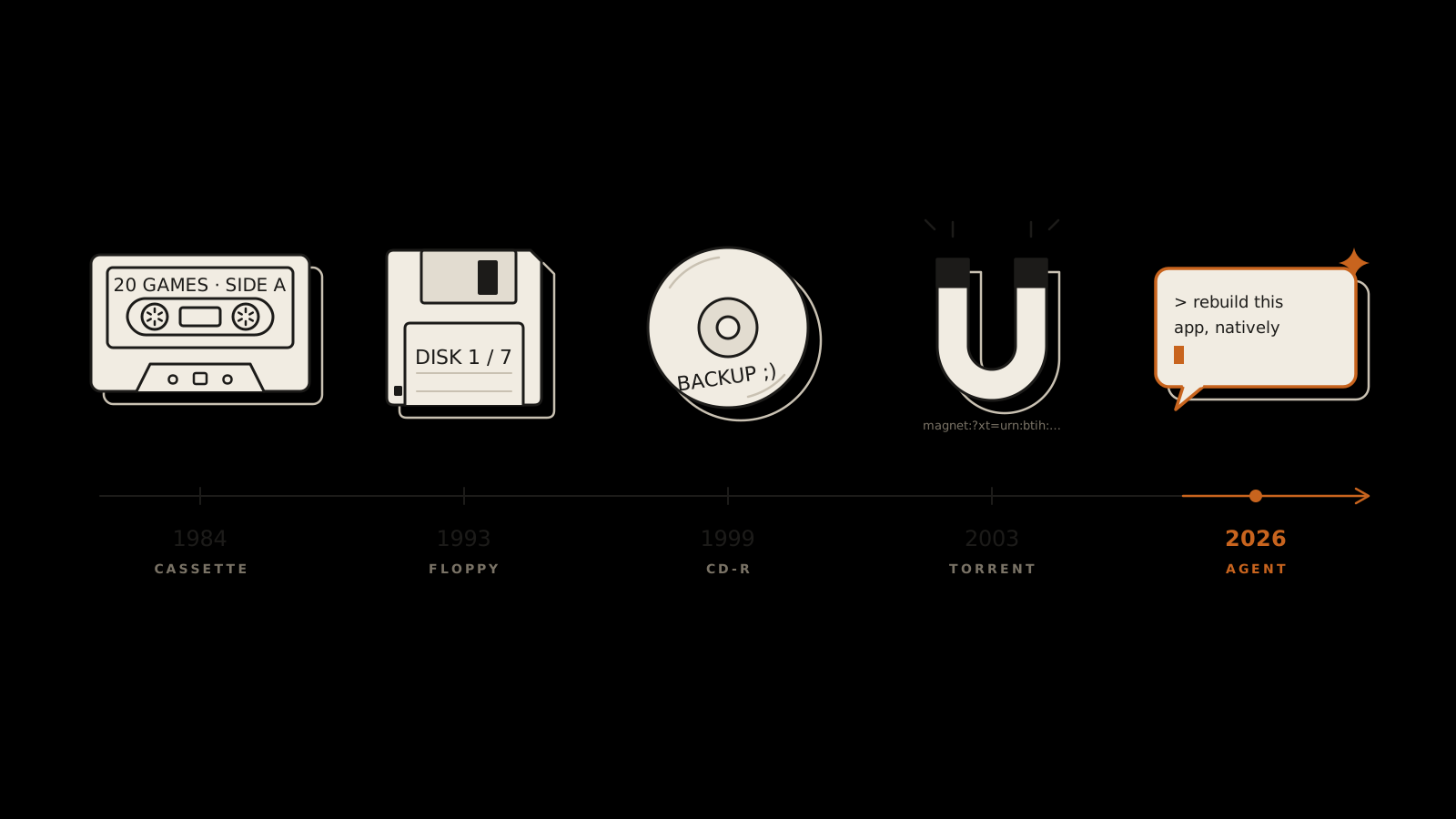
Software will not end. Copying it gets cheaper, as it did with every floppy disk, every CD burner and every torrent tracker before, and the people who need it to work keep paying for it.
So yes, in a way, it is the end of software as we know it. Copying it is now practically free. What we pay for is somebody on the other end who answers when it breaks, and that part, no model has cloned yet.